
![[Translate to Englisch:] Alternativer](/fileadmin/Fernsehturm/fernsehturm-vignette_weiss.svg "[Translate to Englisch:] Titel")
The Birth of the TV Tower
When the then Süddeutscher Rundfunk broadcasting company started planning a new television transmission tower for Stuttgart and its densely populated surroundings in 1953, no one could have imagined that it would spark a revolution in tower construction worldwide.
In 1953, Stuttgart had no television transmitter. Fair reception was only available at high altitudes or with special antennas. When Queen Elizabeth II’s coronation was broadcast on television in June 1953, the people of Stuttgart missed out on the event. There were fears that there would be even more dissatisfied customers when the World Cup kicked off in Switzerland a year later. Retailers also complained because they couldn’t sell TVs while people weren’t able to watch them. The devices had become cheaper in the meantime and interest was growing.
A tower for more than just technology
Originally, Süddeutscher Rundfunk had been planning to build a 200-meter-high steel lattice mast secured with steel cables for its antennas, and it was supposed to be ready by the late summer of 1954.
Professor Fritz Leonhardt, the government-appointed master builder and consulting civil engineer for bridge and building construction, happened to hear about the plans. He felt that a lattice mast would spoil the view of the hills around Stuttgart. He got Helmut Rupp, Technical Director of SDR, Director Fritz Eberhard, and Administrative Director Friedrich Müller excited about his idea of building a viewing tower with a restaurant instead of a purely functional building.
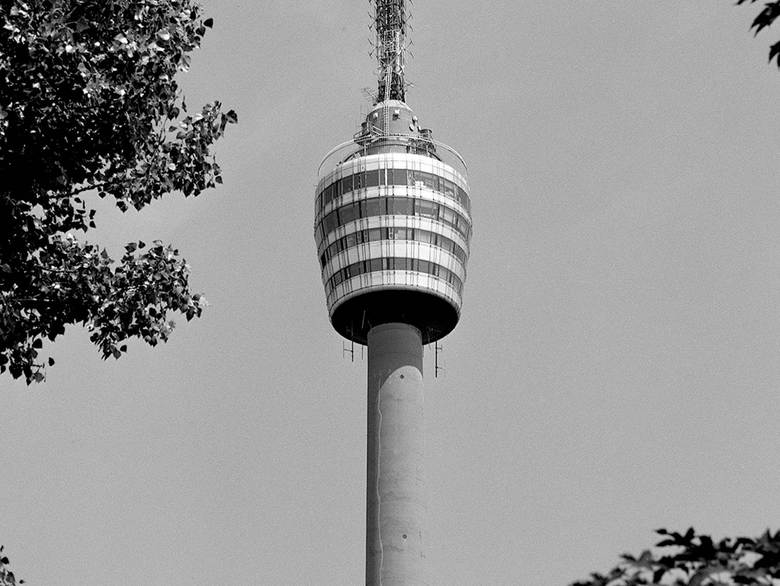
It was not just the design that was new about his idea, but also the suggestion that the building could be used for tourism and hospitality. The result was an elegant tower with an almost circular pod that incorporated a viewing platform, restaurant, and broadcasting equipment.
At 283 meters above the Stuttgart basin, the Hohe Bopser proved to be a suitable location for a television transmitter. It enabled the broadcasting company to guarantee reception in every valley in the county.
Manifold challenges
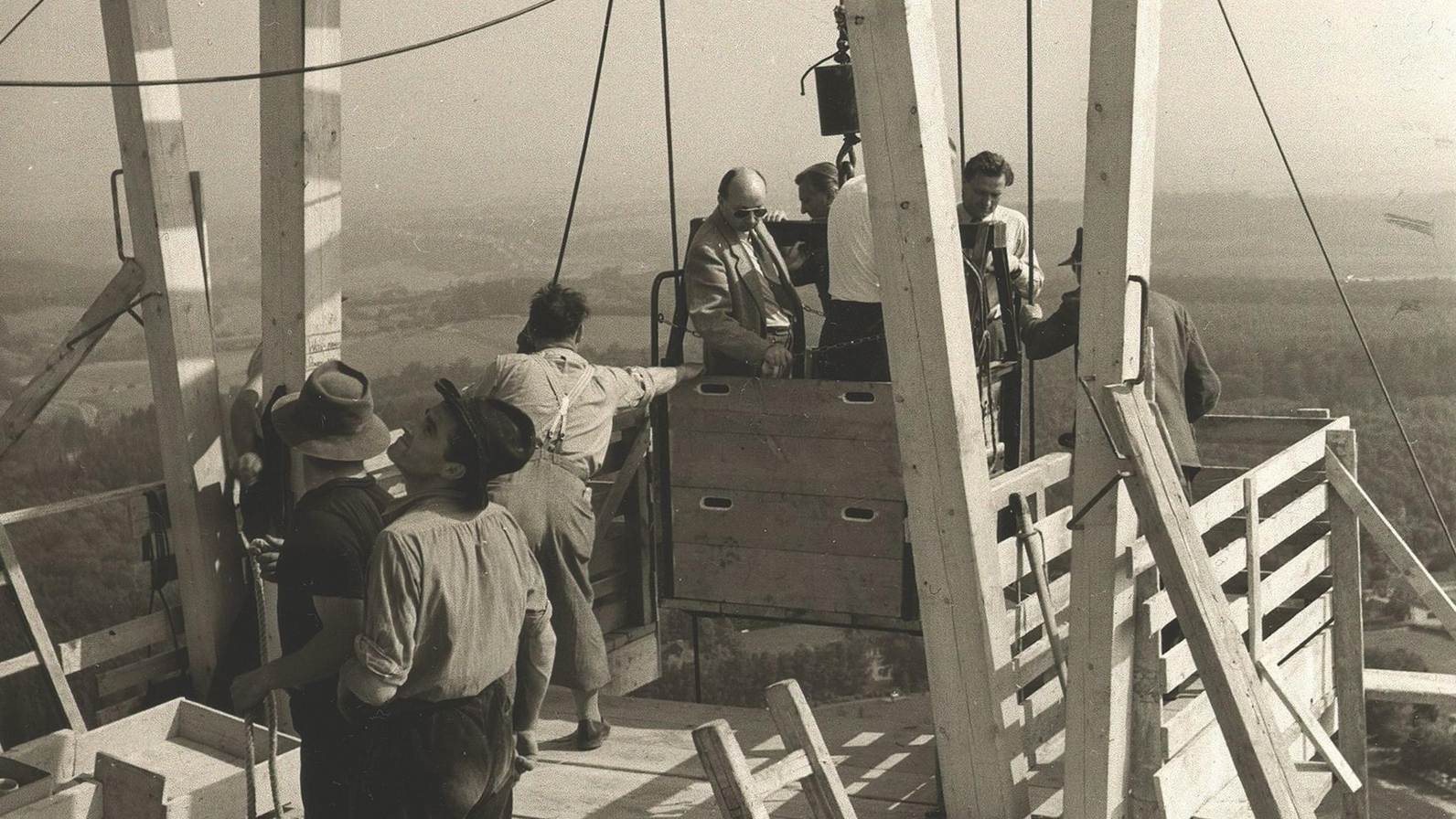
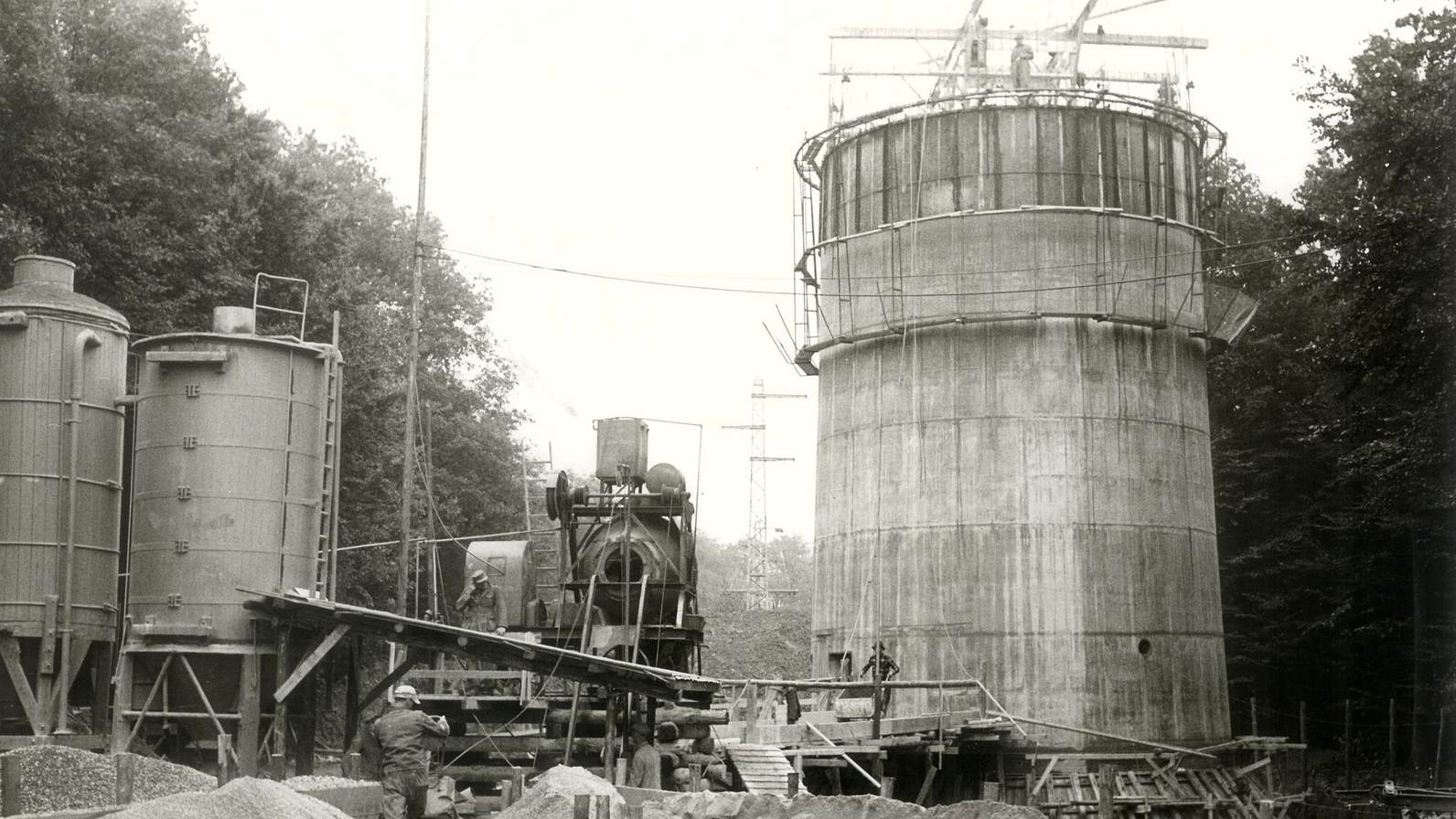
The initially controversial project got underway. Some members of the Stuttgart City Council feared a financial disaster. Following months of negotiations with the city, the SDR’s administrative board decided in May 1954 to finance the TV tower itself and to start construction immediately. The bulldozers rolled in on June 10, 1954. Following Leonhardt’s plans, the Tower was built in just 20 months. Architect Erwin Heinle assumed overall artistic and technical responsibility.
The citizens of Stuttgart protested when the tower began to rise above the treetops and became visible from far and wide. Letters to the editor described it as a foolish prank, an eyesore, or a foreign object in the beautiful forest landscape.
After 20 months of construction, the Stuttgart TV Tower was inaugurated on February 5, 1956. It became a prototype that would be replicated and refined around the world – from Frankfurt, Dortmund and Johannesburg to Wuhan in China.
The construction costs of 4.2 million marks were recouped in just five years through TV licensing fees.
Stuttgart’s landmark
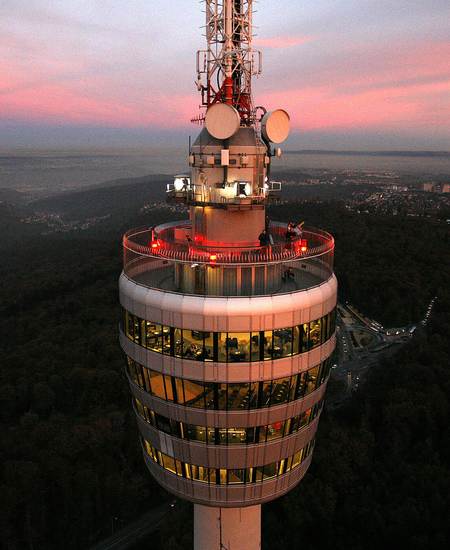
Today, the SWR TV Tower is one of Stuttgart’s most famous landmarks. There is no other spot in Stuttgart that offers such an impressive view of the city, the vineyards in the Neckar Valley, the Swabian countryside, the Alb, the Black Forest, and the Odenwald.
Timeline
ANNIVERSARY
The SWR TV Tower celebrates its 70th anniversary.
RENOVATION
The shaft’s reinforced concrete is repaired in accordance with monument-preservation guidelines and given a new coating, generously supported by Baden-Württemberg’s Monument Preservation Foundation.
OPEN MONUMENT DAY
For the first time, the Tower is one of the organizers of Germany’s largest cultural event dedicated to monument preservation.
UEFA EUROS
The Swiss national soccer team moves into its European Championship quarters at Waldau and trains in the neighboring Waldau Stadium. Despite offering a good view of the pitch, the TV Tower provides the necessary privacy. The Swiss national team makes it to the quarter finals in the tournament.
EN ROUTE TO BECOMING A UNESCO WORLD HERITAGE SITE
In a proposal by the state of Baden-Württemberg, the Tower is added to the German shortlist for UNESCO World Heritage status.
REBRANDING
Following an initiative by SWR Director General Kai Gniffke, the “Stuttgart TV Tower” is renamed “SWR TV Tower Stuttgart”, making its direct connection to SWR and its programs much more apparent.
Crime drama: SOKO STUTTGART ERMITTELT
The popular ZDF TV channel crime series is filmed at the Tower and the episode “Tod im Turm” (Death in the Tower) aires.
VIBRANCY MUSIC
Electric live act from Berlin, BONDI, plays an exclusive DJ set on the platform, live streamed on YouTube.
AROUND THE CLOCK
The TV Tower turns 60 and, for the first time ever, stays open around the clock on its anniversary.
TOWER REOPENS
After almost three years, the TV Tower reopens to the public, boasting a new shop, a new lobby, and the same wonderful view.
FIRE-SAFETY OPTIMIZATION
Following agreement between the City of Stuttgart and SWR Media Services GmbH, the operator of the SWR TV Tower, on how to finance and optimize fire safety at the Stuttgart TV Tower, construction work begins.
TOWER CLOSURE
For the first time in 57 years, and having welcomed 27 million visitors to enjoy the view without incident, the tower is closed to the public due to a city ordinance on fire safety grounds.
FROM FLOOR TO CEILING
Reopening of the restaurant facilities (café, restaurant, beer garden, and shop) after year-long renovation work.
KNIGHTHOOD
On what would have been Fritz Leonhardt’s 100th birthday, the Federal Chamber of Engineers awards the TV Tower the title “Historic Landmark of Civil Engineering in Germany”. At 53 years old, the Tower is the youngest civil engineering structure to have been awarded this title to date.
UNPLUGGED
TV antennas are decommissioned.
THE HEIGHT OF CULTURE
First theater performances as part of the “Theater über den Wolken” (Theater above the Clouds) series.
HAPPY “TOWER DAY”
The TV Tower celebrates its 50th anniversary.
WAYMARK
Installation of the steel sculpture ‘Wegezeichen 7’ (Waymark 7) by famous Stuttgart-based sculptor Professor O. H. Hajek.
FIRST CLOSURE
The pod’s exterior cladding is renovated, and the Tower is closed for the first time. For financial reasons, the restaurant and kitchen floors remain unfinished.
WORLD RECORD ATTEMPT
High-wire stunt by artist Johann Traber at a height of 53 meters up the TV Tower shaft in a Smart car.
(FACE)LIFT
Renovation of the entire elevator system and lobby.
BASE-JUMPS
For the first time, legally sanctioned parachute jumps take place with parachute world champion Klaus Renz and a group of international BASE jumpers.
CULINARY DELIGHTS
Hospitality lease agreement with Willi Weber, F1 driver Michael Schumacher’s manager. Armin Karrer runs the award-winning restaurant “Webers Gourmet”.
LES INGENIEURS DU SIECLE
Fritz Leonhardt’s Stuttgart TV Tower is featured at the major exhibition “Les Ingenieurs du Siecle” at the Centre Georges Pompidou in Paris.
COSMETIC REPAIRS
The Tower shaft is completely refurbished for the first time in a complex and weather-dependent process. Cracks and weathering have made cosmetic repairs necessary. The transmission mast is also given a new coat of paint.
WIND ART INSTALLATION “INTER-INFO”
As part of the Expo 93 International Garden Exhibition, Slovenian artist Branko Šmon attaches large, bright red windsocks to three steel cables stretching from the ground to the Tower pod. Moving playfully in the wind depending on its strength and direction, they are visible from far and wide.
“LIGHT SIGNAL” CAMPAIGN
Green and red lights winding their way up the Tower turn it into a memorial to warn of the impending climate catastrophe for five nights. The Pforzheim-based environmental company “Ritter” designed the campaign in collaboration with the University of Applied Sciences Pforzheim.
CULTURAL MONUMENT
The Tower is declared a cultural monument of special significance under the Monument Protection Act as one of the defining examples of post-war architecture and is listed in the City of Stuttgart’s monument register.
THE ELEPHANT
A newly designed gondola used to clean the windows is commissioned.
LOOKING GOOD
After nine months of renovation work, the guest space in the TV Tower reopens.
FM
A new FM antenna is commissioned.
MEETING PLACE
The television series “Treffpunkt Fernsehturm” (Meeting Place: TV Tower) premieres on the channel Südwest 3.
LUNCH BREAK
The restaurant at the base of the Tower is renovated.
... FOR THE THIRD TIME
The third generation of television is installed at the base of the Tower.
EVERYTHING BECOMES MORE COLORFUL
Color TV is introduced, a second transmitter is installed, and the old one is replaced.
THE TOWER GROWS
The modified TV antenna system is put into operation. The Tower is raised by 6 meters and now measures 217 meters.
Visit by the Queen
Queen Elizabeth II and her husband Prince Philip visit the TV Tower and sign the Golden Book of the City. The SDR broadcasts the event live, as 500,000 viewers watch the spectacle on their TVs.
GROUNDBREAKING
A panoramic indicator is installed on the observation deck, providing information about surrounding landmarks.
PAUL BONATZ ARCHITECTURE AWARD
The city of Stuttgart awards the Paul Bonatz Architecture Prize. The prize goes to the TV Tower in the civil engineering category.
SAFETY FIRST
Installation of the security fence on the platform
RADIO GOES LIVE
The FM transmitters for radio broadcasting go live.
INAUGURATION
Inauguration of the Stuttgart TV Tower.
GO-LIVE
On October 29, 1955, even before the Tower is inaugurated, SDR starts broadcasting. TV reception in the greater Stuttgart area is finally guaranteed.
CONSTRUCTION STARTS
Südfunk Director Dr. Fritz Eberhard digs the first spadeful of earth.
LAUNCH OF GERMAN TELEVISION BROADCASTING
On Christmas Day, December 25, 1952, television broadcasting officially resumes after World War II, with the first Tagesschau news program airing the following day. But only a few people get to see the birth of German TV. At that point, only about 4,000 TVs have been sold for 1,150 German Marks each. Not many people can afford one.
LAUNCH OF GERMAN TELEVISION BROADCASTING
On Christmas Day, December 25, 1952, television broadcasting officially resumes after World War II, with the first Tagesschau news program airing the following day. But only a few people get to see the birth of German TV. At that point, only about 4,000 TVs have been sold for 1,150 German Marks each. Not many people can afford one.